
How Fast Are Homes Selling in Atlanta? Current Days on Market
If you're thinking about selling your home in Atlanta, one of the first questions you'll probably ask is: How long will it take to sell?
Will your home receive an offer within a week, sit on the market for a month, or take several months to find the right buyer?
The answer depends on more than just the Atlanta real estate market. Your home's location, asking price, condition, presentation, and competition all play a role in how quickly it sells.
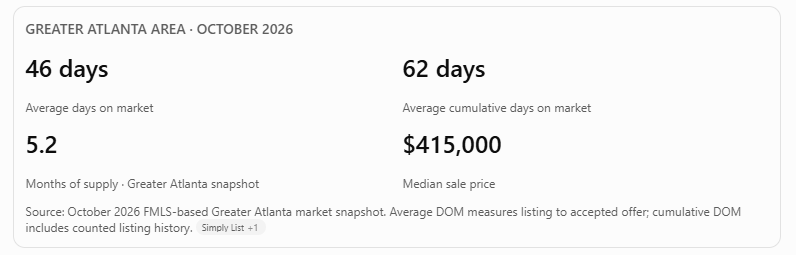
As of October 2026, homes in the Greater Atlanta area are taking an average of approximately 46 days to receive an accepted offer, based on the latest available FMLS-based market snapshot. When previous listing history is included, average cumulative days on market rises to approximately 62 days.
So, what does that actually mean for Atlanta homeowners? Let's look at the latest numbers, what influences selling time, and what you can do to help your home attract buyers.
How Long Are Homes Taking to Sell in Atlanta Right Now?
According to the October 2026 Greater Atlanta market snapshot, the average days on market (DOM) is 46 days.
Here's a closer look at the latest available figures:
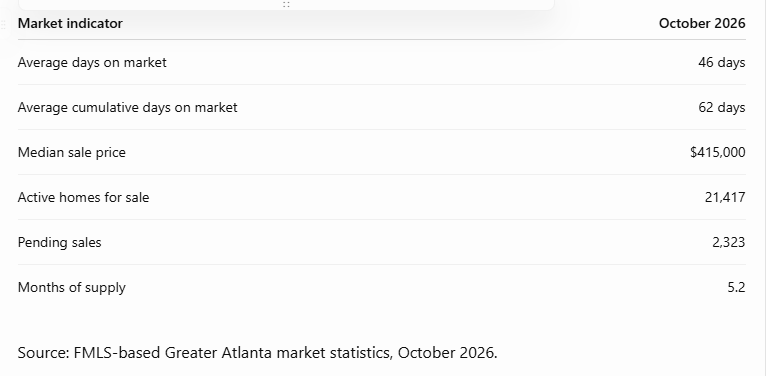
These numbers provide a helpful snapshot of the market, but it's important to understand what they measure.
Days on market (DOM) generally measures how long a property is marketed before an offer is accepted, according to the reporting system's methodology.
Cumulative days on market (CDOM) also accounts for qualifying previous listing history. This matters because a property that was listed, withdrawn, and relisted may have a longer marketing history than its current listing date suggests.
These figures do not mean every Atlanta home will sell in exactly 46 or 62 days. Some properties sell much faster, while others take considerably longer.
Source: Greater Atlanta Market Statistics.

Is Atlanta a Buyer's Market or a Seller's Market?
Another important factor when evaluating how quickly homes are selling is the amount of available inventory.
In October 2026, the Greater Atlanta market snapshot reported approximately 5.2 months of housing supply.
Months of supply estimates how long it would take to sell the current inventory at the prevailing pace of sales, assuming no additional homes entered the market.
Generally:
- Less than 4 months of supply often indicates a seller-favorable market.
- Around 4 to 6 months may indicate a more balanced market.
- More than 6 months can indicate greater buyer leverage.
These are general industry guidelines, not rigid classifications.
With approximately 5.2 months of supply, Greater Atlanta is closer to a balanced market than an extremely competitive seller's market.
What does that mean if you're selling?
Buyers have more properties to compare, which means pricing and presentation matter. Sellers may need to be more strategic when determining their asking price and negotiating offers.
It doesn't mean homes aren't selling. It means buyers have more choices and may be less willing to overlook overpriced listings.

Atlanta vs. Metro Atlanta: Why the Numbers Can Be Different
When researching Atlanta real estate statistics, you may notice that different websites report different days-on-market figures.
That's not necessarily a mistake.
Some reports measure the City of Atlanta, while others cover a broader metropolitan area or a specific group of counties. Different providers may also calculate days on market differently.
For example, Realtor.com reported a median of 60 days on market for Atlanta in September 2026, while Redfin reported approximately 63 days for the three months ending September 2026.
These numbers are not directly interchangeable with the 46-day Greater Atlanta average for October because they use different reporting periods, geographic definitions, and methodologies.
Sources:
The takeaway? Before relying on a days-on-market statistic, check which area it covers, whether it is an average or median, and how the number is calculated.
For sellers, neighborhood-level data is usually more useful than a single citywide or regional number.

What Determines How Quickly Your Atlanta Home Will Sell?
Two homes can be listed on the same day, in the same city, and have completely different selling timelines.
Here are some of the biggest factors that influence how quickly a home attracts an offer.
1. Your Asking Price
Pricing is one of the most important decisions you'll make before listing.
If your home is priced significantly above comparable properties, buyers may overlook it in favor of better-priced alternatives.
On the other hand, pricing competitively from the beginning can help generate interest and encourage more showings.
A good pricing strategy should consider recently sold homes, current competition, property condition, location, and buyer demand.
Remember: The goal isn't simply to list at the highest possible price. It's to position your home where qualified buyers see its value.
2. Location and Neighborhood Demand
Atlanta is made up of many different housing markets.
A property in Buckhead may attract a different buyer pool than one in East Atlanta, West Midtown, or Southwest Atlanta.
The same is true for surrounding communities such as:
- Alpharetta
- Marietta
- Roswell
- Smyrna
- Decatur
- Johns Creek
- Sandy Springs
- Woodstock
Each area has different price points, housing inventory, buyer preferences, and neighborhood characteristics.
Even within the same city, homes in different neighborhoods can experience very different selling timelines.


3. Property Condition and Presentation
Buyers often form their first impression before they ever step inside the home.
Professional photography, clean spaces, attractive landscaping, and well-maintained interiors can help a listing stand out.
Before listing, consider addressing visible maintenance issues, decluttering, improving curb appeal, and making necessary repairs.
You don't necessarily need an expensive renovation. Sometimes a few strategic improvements can make a noticeable difference in how buyers perceive the property.
4. Marketing and Online Visibility
Most buyers begin their home search online.
That means your listing needs more than a price and a few photographs.
High-quality images, accurate property descriptions, detailed listing information, and effective exposure across relevant real estate platforms can help your home reach potential buyers.
Depending on the property, professional photography, video tours, virtual tours, and targeted marketing may also be worth considering.
The objective is to help buyers understand what makes your home worth visiting.


5. Competition From Other Listings
Your home isn't being evaluated in isolation.
Buyers are comparing it with other available properties in the same price range and area.
If several similar homes are listed nearby, your property needs a clear competitive advantage.
That advantage might be better condition, a more functional layout, updated features, a desirable location, or a more competitive price.
Understanding your competition before listing can help you avoid pricing and marketing mistakes.
What If Your Home Has Been on the Market for 30, 45, or 60 Days?
If your property hasn't received an offer after several weeks, it may be time to review your selling strategy.
Here are some questions worth asking:
Has the price been competitive?
Compare your listing with recently sold properties and homes currently competing for buyers.
Are buyers scheduling showings?
If online views are strong but showings are limited, your price, photographs, or listing presentation may need attention.
Are buyers visiting but not making offers?
Review showing feedback. Buyers may be noticing condition issues, layout limitations, or features that aren't meeting their expectations.
Has the market changed since you listed?
New competing properties, price reductions, and changing buyer demand can affect your home's position in the market.
A longer marketing period doesn't automatically mean something is wrong with your property. However, it is an opportunity to evaluate what's working and what needs to change.

5 Ways to Help Your Atlanta Home Sell Faster
While no strategy can guarantee a quick sale, there are practical steps sellers can take to improve their home's marketability.
1. Price Based on Comparable Sales
Work with a real estate professional to review recent sales and current competition.
Avoid relying solely on online estimates or what a neighbor received for a different property.
2. Prepare Your Home Before Listing
Take care of visible maintenance issues, clean thoroughly, remove unnecessary clutter, and make sure the property is ready for photographs and showings.
3. Invest in Professional Listing Photography
Your online listing is often a buyer's first introduction to your home. Clear, well-composed photographs can help showcase the property's features and encourage in-person visits.
4. Make Showings Convenient
The easier it is for buyers and their agents to schedule a showing, the more opportunities you may have to generate interest.
Whenever possible, maintain a clean and accessible property during the listing period.
5. Review Feedback and Adjust When Necessary
Pay attention to showing activity, buyer comments, competing listings, and changes in the local market.
If the home isn't attracting the expected attention, discuss potential adjustments with your agent rather than waiting indefinitely.

Should You Sell Your Atlanta Home Now or Wait?
The right time to sell depends on your personal circumstances and the conditions in your specific neighborhood.
A market with more inventory may require a more thoughtful pricing and marketing strategy, but it can still offer opportunities for sellers with well-positioned properties.
Before deciding when to list, consider:
- Your home's current market value
- The number of competing properties nearby
- Recent comparable sales
- Your financial and moving timeline
- Seasonal buyer activity
- The availability of your next home, if you're purchasing again
Rather than trying to predict the perfect month to sell, focus on understanding your property's position in the current market.
The Bottom Line: How Fast Are Atlanta Homes Actually Selling?
As of October 2026, the Greater Atlanta market snapshot reports an average of 46 days on market and 62 cumulative days on market.
That gives homeowners a useful starting point when planning a sale, but it shouldn't be treated as a guaranteed selling timeline.
Some properties attract offers quickly because they're priced appropriately, well-presented, and aligned with current buyer demand. Others need more time, adjustments, or additional marketing.
The most important thing is to understand how your home compares with similar properties in your immediate area.
Thinking about selling your home in Atlanta or the surrounding Metro Atlanta communities? Let's look at your property's current market position, review comparable sales, and develop a pricing and marketing strategy designed to attract the right buyers.
Your home deserves more than a listing date. It deserves a plan.